
Gasflow Terminal
26 services. Turbine logic. Full gas processing topology.
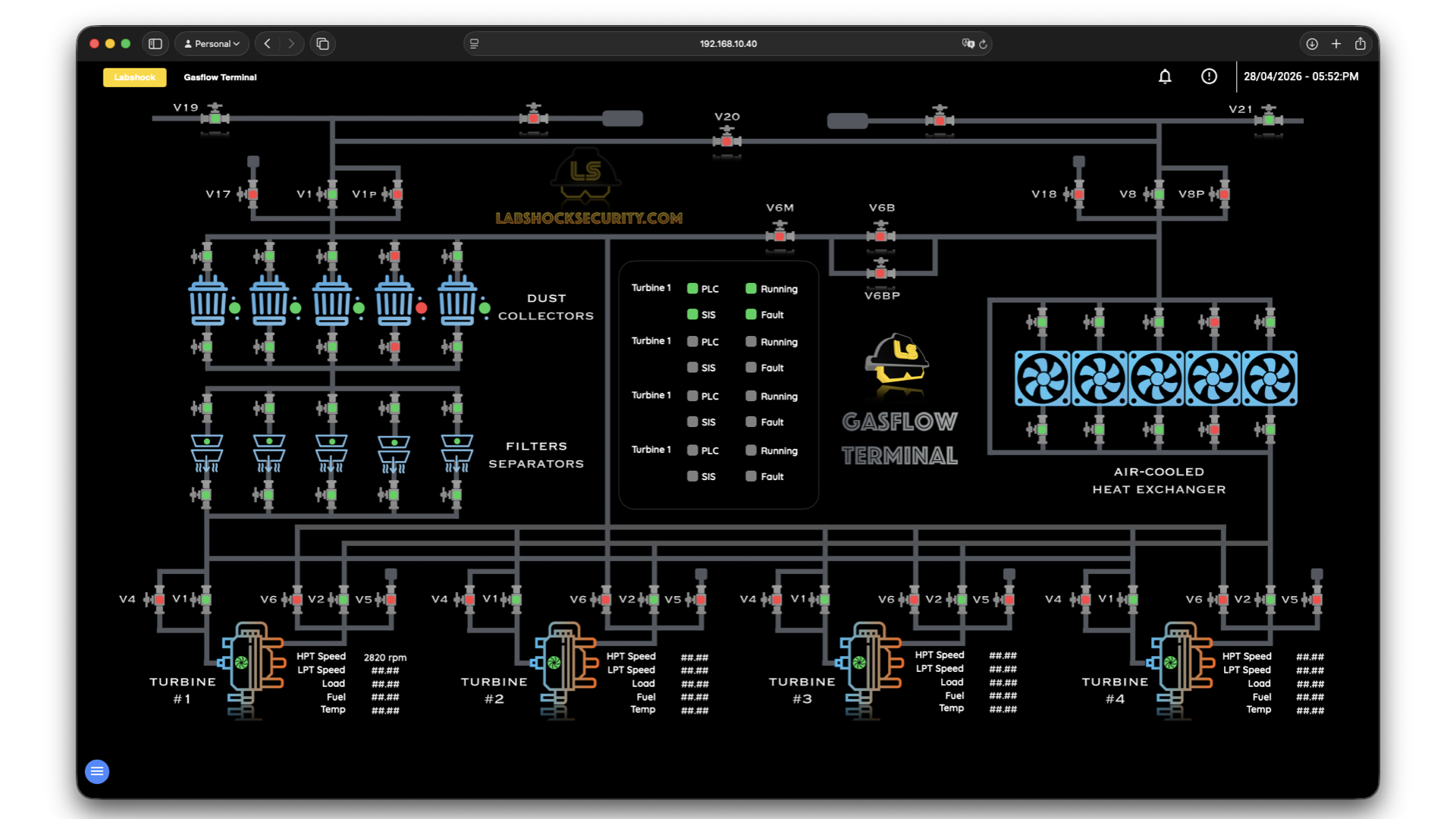
Gasflow Terminal is a large-scale industrial gas transport station simulation built around multiple turbine-driven compressor units.
The environment models a distributed control architecture where each turbine operates with its own local PLC and HMI layer, while a central SCADA system aggregates telemetry, coordinates load balancing, and maintains system-wide stability.
Users interact with a complex industrial topology that includes process control loops for combustion, rotation, airflow regulation, lubrication systems, and startup sequencing. The lab reflects real-world constraints such as redundant sensing, safety interlocks, and deterministic control cycles.
Gasflow Terminal is designed to simulate enterprise-level industrial complexity, where multiple subsystems interact continuously under strict operational constraints.
Gasflow Terminal was designed to replicate a modern gas compression facility where operational continuity depends on tightly coordinated turbine systems.
Four high-capacity turbine units work in parallel, each contributing to pipeline pressure regulation across a distributed network. A central SCADA system oversees global stability, while local controllers handle high-speed process regulation.
The system is engineered for continuous operation under strict reliability and safety requirements. Over time, layered integrations and incremental upgrades have increased architectural complexity, creating deep interdependencies between control, monitoring, and safety subsystems.